
The 30-Second Workshop Rule: Keep Tools Within Reach

The 30-Second Workshop Rule
A socket falls just beyond reach.
The correct wrench is still on the workbench.
A spray bottle sits on the opposite side of the vehicle.
None of these delays feels important. Repeated throughout the day, however, they interrupt concentration and turn a straightforward repair into a constant cycle of standing, searching and sitting again.
A rolling mechanic seat with tool storage brings seating, mobility and organization into one compact workstation.
A better workshop seat does more than support the technician. It keeps the next tool close enough to maintain the workflow.
Sit Low. Move Easily. Stay Focused.
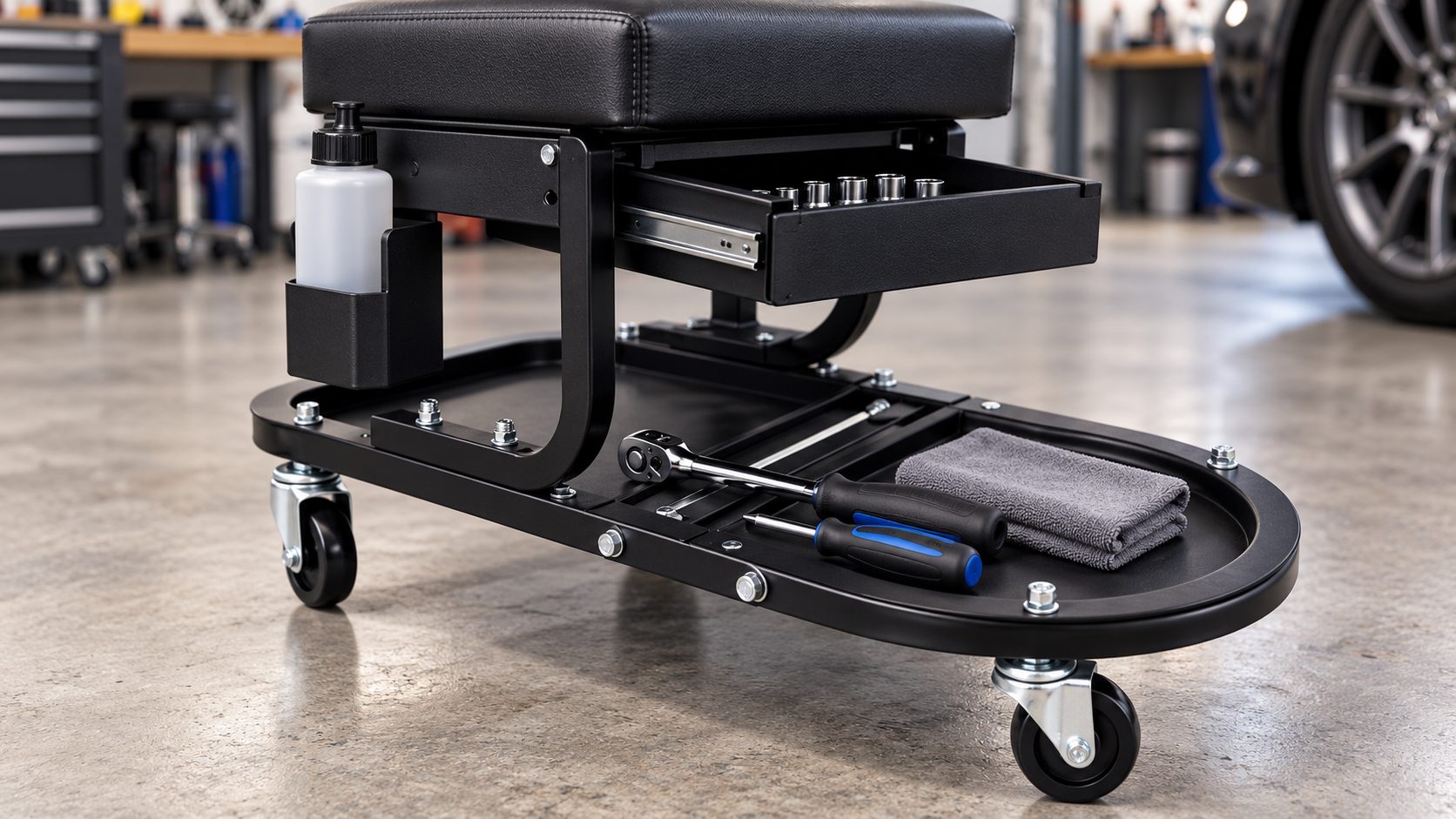
Automotive repair often requires technicians to work near wheels, brakes, body panels and lower vehicle components.
The padded seat creates a defined sitting position, while the swivel casters allow the user to reposition the stool across a suitable workshop floor.
Instead of repeatedly standing to move the seat, the technician can roll between nearby working areas while remaining close to the task.
Storage Where the Work Happens
The lower platform provides space for frequently used tools and supplies. This model also includes a storage drawer for smaller components that should remain separated from the open tray.
Depending on the final configuration, the storage areas may hold:
Sockets and ratchets
Wrenches and screwdrivers
Cleaning cloths
Inspection tools
Small replacement parts
Compatible bottles or spray containers
Tools should be distributed evenly and kept clear of the caster wheels.
Open Tray or Drawer: Why Use Both?
The open tray is suitable for equipment that must be reached quickly. The drawer creates a more enclosed area for smaller items.
Storage Area | Best Used For |
|---|---|
Open lower tray | Frequently used hand tools and larger supplies |
Storage drawer | Small parts, sockets and accessories |
Side holders | Compatible bottles or narrow tools |
Seat level | Working position only—not tool storage |
This combination helps separate “use now” tools from “keep nearby” items.
The Workflow Audit
A workshop buyer should observe how the seat performs during a complete repair task.
Before the Job
Are the required tools easy to load?
Does the drawer open smoothly?
Are the casters aligned correctly?
Is the seat stable on the workshop floor?
During the Job
Can the user reach the tray without excessive twisting?
Does the stool roll smoothly under controlled movement?
Do tools remain inside the storage areas?
Does the frame remain stable when the user changes position?
After the Job
Can tools be removed quickly?
Is the tray easy to clean?
Can the drawer be inspected and maintained?
Does the product store efficiently between tasks?
A product that performs well through all three stages offers more value than one judged only by appearance.
What Buyers Should Examine Closely
Before sourcing a garage creeper seat, buyers should confirm:
Frame material and thickness
Seat dimensions and padding
Caster diameter and construction
Tray depth and layout
Drawer structure and slide mechanism
Bottle-holder dimensions
Verified load capacity
Stability and durability tests
Surface-finish requirements
Packaging and assembly method
Specific performance claims should be based on confirmed drawings and product testing.
Who Is This Product Designed For?
This type of mechanic stool with wheels may be suitable for:
Automotive repair workshops
Tire and brake service centers
Motorcycle maintenance
Detailing facilities
Home garages
Industrial maintenance departments
Automotive-tool retailers
The final configuration should match the intended task, working height and floor conditions.
OEM/ODM Rolling Mechanic Seat Manufacturing
TWS Industries supports customized mechanic seating for tool brands, importers, distributors and garage-equipment retailers.
Customization options may include:
Frame dimensions
Seat material and color
Padding thickness
Tool-tray layout
Drawer configuration
Caster specifications
Bottle and accessory holders
Surface finish
Custom logo and labels
Retail or export packaging
Final specifications should be approved through technical drawings, samples and appropriate testing before mass production.
The Real Value Is Continuity
A workshop does not lose time only through major delays.
It also loses time through dozens of small interruptions: one missing socket, one misplaced tool and one unnecessary walk back to the bench.
A well-designed automotive repair seat keeps the technician mobile, supported and organized—so the work can continue without repeatedly breaking its rhythm.
Contact TWS Industries for OEM/ODM development, samples and customized bulk-order quotations.