
How a Rolling Mechanic Stool Improves the Complete Repair Workflow

How a Rolling Mechanic Stool Improves the Complete Repair Workflow
Automotive repair often requires technicians to work close to the floor while repeatedly reaching for tools, fasteners and replacement parts. A standard workshop stool may provide a seat, but it does not necessarily keep equipment organized.
A rolling mechanic stool with storage combines a padded seat, mobile steel frame and integrated tool compartments in one compact workstation.
Before the Job: Prepare the Tools
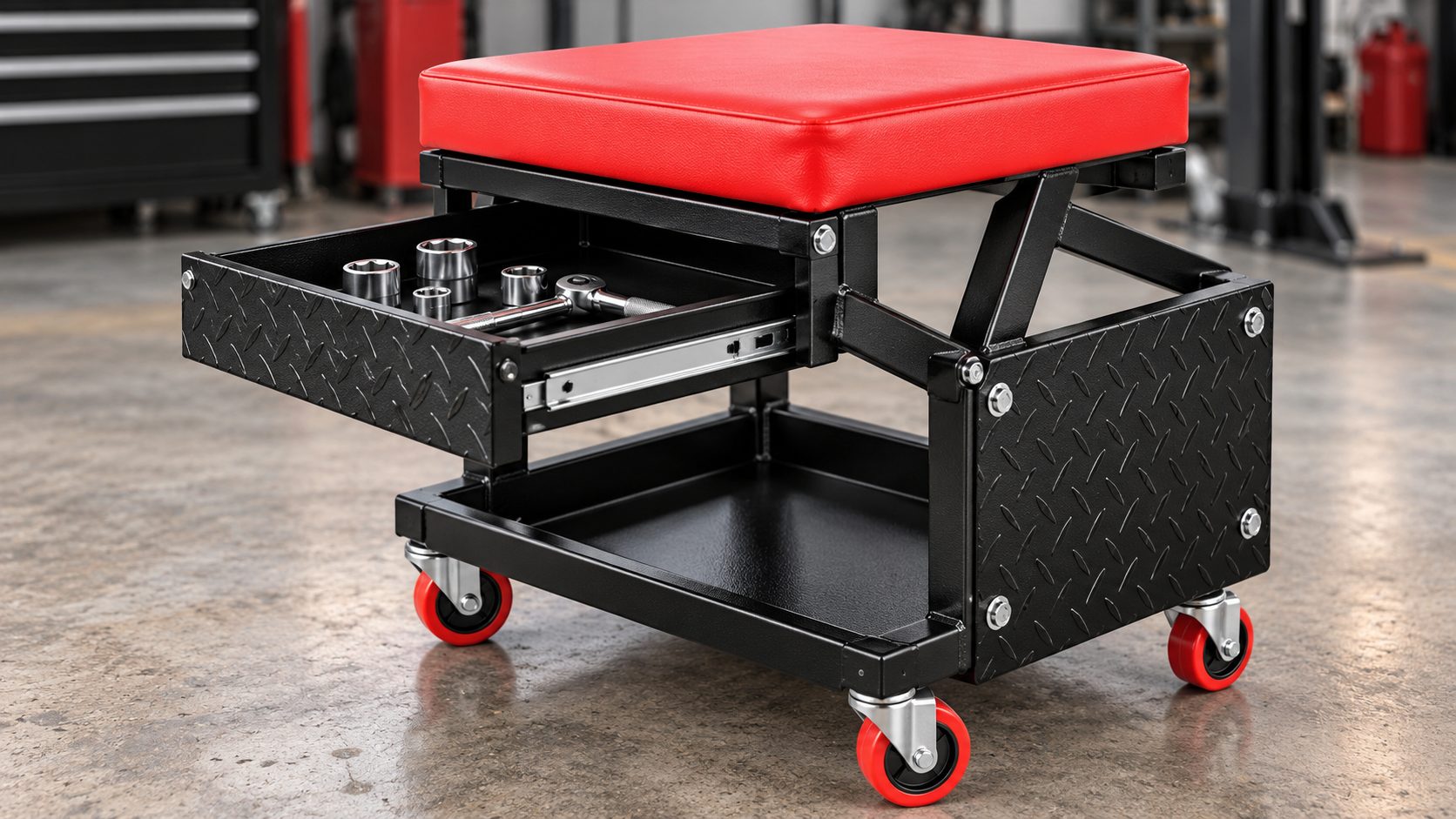
An efficient repair begins before the technician sits down. Frequently used tools, parts and supplies should be placed within easy reach.
The illustrated stool includes several storage areas that may be used for:
Hand tools
Sockets and wrenches
Small replacement parts
Fasteners
Cleaning supplies
Personal protective equipment
Preparing these items in advance can reduce repeated trips between the vehicle and the main toolbox.
Keep Small Items in the Drawer
A pull-out drawer provides enclosed storage for smaller tools and components. It may help prevent frequently used items from becoming mixed with larger equipment.
Buyers should confirm:
Internal drawer dimensions
Slide construction
Drawer-stop mechanism
Maximum supported load
Handle design
Opening clearance
Retention during movement
The drawer should remain properly aligned when the stool is moved across a suitable workshop floor.
Use the Lower Tray for Larger Equipment
The open lower tray offers visible storage for larger tools and supplies that need to remain accessible during work.
Compared with a closed compartment, an open shelf allows technicians to check its contents quickly. Raised edges may help prevent tools from sliding out, but their effectiveness depends on the tray depth and wheel movement.
During the Job: Work from a Mobile Seated Position
The padded upper seat supports work performed near wheels, brakes, body panels and lower vehicle components.
Swivel casters allow the user to reposition the stool without lifting the complete frame. This may be useful when moving along the side of a vehicle or between nearby work areas.
Movement should always take place on a firm, level and unobstructed floor.
Why Seat Construction Matters
Workshop seating must balance comfort with structural support.
Important specifications include:
Cushion dimensions
Padding thickness
Upholstery material
Seat-base construction
Frame connection
Edge finishing
Cleaning requirements
The illustrated red cushion creates a strong visual contrast with the black steel frame and gives the product a recognizable garage-equipment appearance.
Why Caster Selection Matters
Casters directly affect mobility and stability. Buyers should evaluate:
Wheel diameter
Wheel material
Caster construction
Swivel performance
Bearing type
Mounting method
Floor compatibility
Replacement availability
Small casters may perform differently across smooth concrete, tile, floor joints and uneven workshop surfaces.
After the Job: Return Tools to Their Places
Cleanup is easier when every tool already has a defined storage area.
After completing the repair, the user can:
Return small tools to the drawer.
Place larger items in the lower tray.
Remove loose fasteners and debris.
Wipe the cushion and steel surfaces.
Inspect the wheels and drawer.
Move the stool back to its storage area.
This routine helps prepare the workstation for the next task.
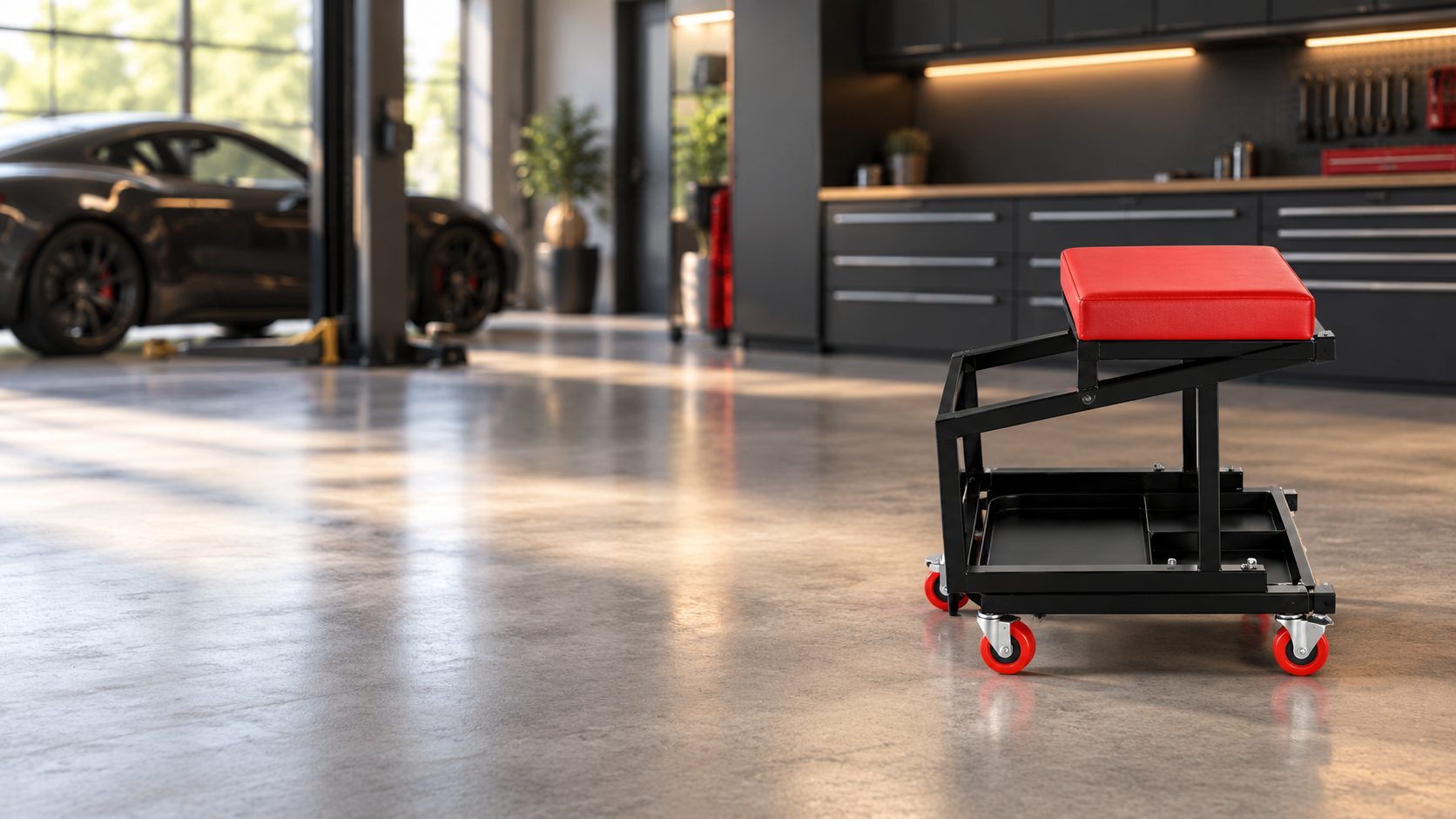
Stool, Tool Cart or Creeper Seat?
Product type | Main function | Storage | Working position |
|---|---|---|---|
Basic workshop stool | Seated support | Limited or none | Upright seated |
Tool cart | Tool transportation | High | User remains standing |
Creeper seat | Low-level mobility | Usually limited | Low seated |
Mechanic stool with storage | Seating and organization | Integrated | Mobile seated |
The best option depends on the working height, required tool capacity and available workshop space.
Steel Frame and Side Panels
The black metal structure supports the seat, drawer, tray and casters. Side panels may provide additional rigidity and help protect stored items.
Commercial buyers should confirm:
Steel grade
Sheet and tube thickness
Frame dimensions
Weld quality
Fastener specifications
Surface preparation
Powder-coating requirements
Sharp-edge control
The frame should be evaluated as a complete loaded assembly rather than as individual components.
Recommended Product Testing
Before publishing final performance claims, buyers should consider:
Static seat-load testing
Dynamic rolling tests
Caster durability
Drawer-cycle testing
Frame-deflection inspection
Tip-stability evaluation
Fastener-retention testing
Coating adhesion
Upholstery durability
Packaging-drop testing
The rated weight capacity should be based on confirmed test results.
Suitable Applications
This product may be suitable for:
Automotive garages
Motorcycle repair shops
Detailing centers
Maintenance departments
Home workshops
Manufacturing facilities
Equipment service centers
Hardware and automotive retailers
OEM/ODM Development Options
TWS Industries supports customized workshop-stool development for international importers, wholesalers, retailers and private-label brands.
Available options may include:
Frame dimensions
Seat height
Cushion color and material
Steel thickness
Drawer configuration
Tray dimensions
Side-panel design
Caster specifications
Powder-coating color
Logo and labeling
Assembly structure
Retail or export packaging
Final specifications should be confirmed through drawings, samples and product testing before mass production.
Request a Customized Quotation

For an accurate quotation, buyers should provide the required dimensions, target weight capacity, storage configuration, caster requirements, surface finish, order quantity, destination market and packaging standard.
A thoughtfully developed rolling mechanic stool with storage supports the complete repair workflow—from tool preparation and mobile seated work to organized cleanup.
Contact TWS Industries for OEM/ODM development, sample preparation and customized bulk-order quotations.