
How a Retractable Hose Reel Improves Workshop Efficiency

How a Retractable Hose Reel Improves Workshop Efficiency
A workshop hose rarely creates a problem while it is being used.
The problem begins when the task ends.
The hose remains stretched across the floor, becomes twisted around equipment or is loosely coiled beside the workstation. What begins as a small inconvenience can gradually affect organization, movement and daily productivity.
A retractable hose reel changes this workflow by giving the hose a defined storage point and a controlled path between storage and use.
Its value is not simply that it holds a hose. Its value lies in how it manages the hose before, during and after every task.
Before the Job: Keep the Hose Ready

In a busy garage or workshop, operators should be able to locate and deploy equipment without spending unnecessary time untangling or repositioning it.
A fixed reel creates a dedicated hose station. The hose remains stored around the drum instead of being left in an irregular coil on the floor.
This may support:
Faster equipment access
More consistent workstation organization
Reduced hose tangling
Better use of wall or overhead space
Cleaner movement routes around machinery
Easier end-of-shift inspection
The actual benefit depends on correct mounting, suitable hose length and placement near the intended work area.
During the Job: Control the Working Length
A hose should reach the task without creating excessive loose material around the operator.
With a retractable reel, the user pulls out the length required for the job while the remaining hose stays stored on the drum. This creates a more controlled working area than releasing the entire hose every time.
The reel should be positioned so that the hose follows a practical route toward the equipment or service point.
Installation planning should consider:
Direction of hose travel
Working radius
Position of vehicles or machinery
Operator movement
Nearby obstacles
Mounting height
Connection to the supply line
Hose bend radius
Poor positioning can create side loading, excessive rubbing or inconvenient pulling angles even when the reel itself is correctly manufactured.
After the Job: Return the Hose to Storage
The end of the task is where the retracting system becomes most valuable.
Instead of manually coiling the hose, the operator guides it back toward the reel. The drum collects the hose within a compact storage area, helping prepare the workstation for the next use.
Retraction should remain controlled. Users should not release the hose and allow the fitting to travel freely toward the reel.
A suitable operating procedure should include:
Disconnect or secure the working tool as required.
Hold the hose firmly.
Guide the hose toward the reel.
Allow the drum to rewind at a controlled speed.
Confirm that the hose is distributed correctly.
Inspect the hose end and connector before storage is completed.
Final instructions should match the reel mechanism and intended application.
The Components That Define Reel Performance
A retractable reel is a system of interacting components. Its performance cannot be evaluated by looking at the drum alone.
1. The Reel Drum
The drum stores the hose and rotates during extension and retraction.
Its diameter and width influence:
Compatible hose dimensions
Hose bending during storage
Winding arrangement
Overall reel size
Installation space
Packaging volume
The drum should rotate without excessive resistance, lateral movement or contact with the supporting frame.
2. The Structural Frame
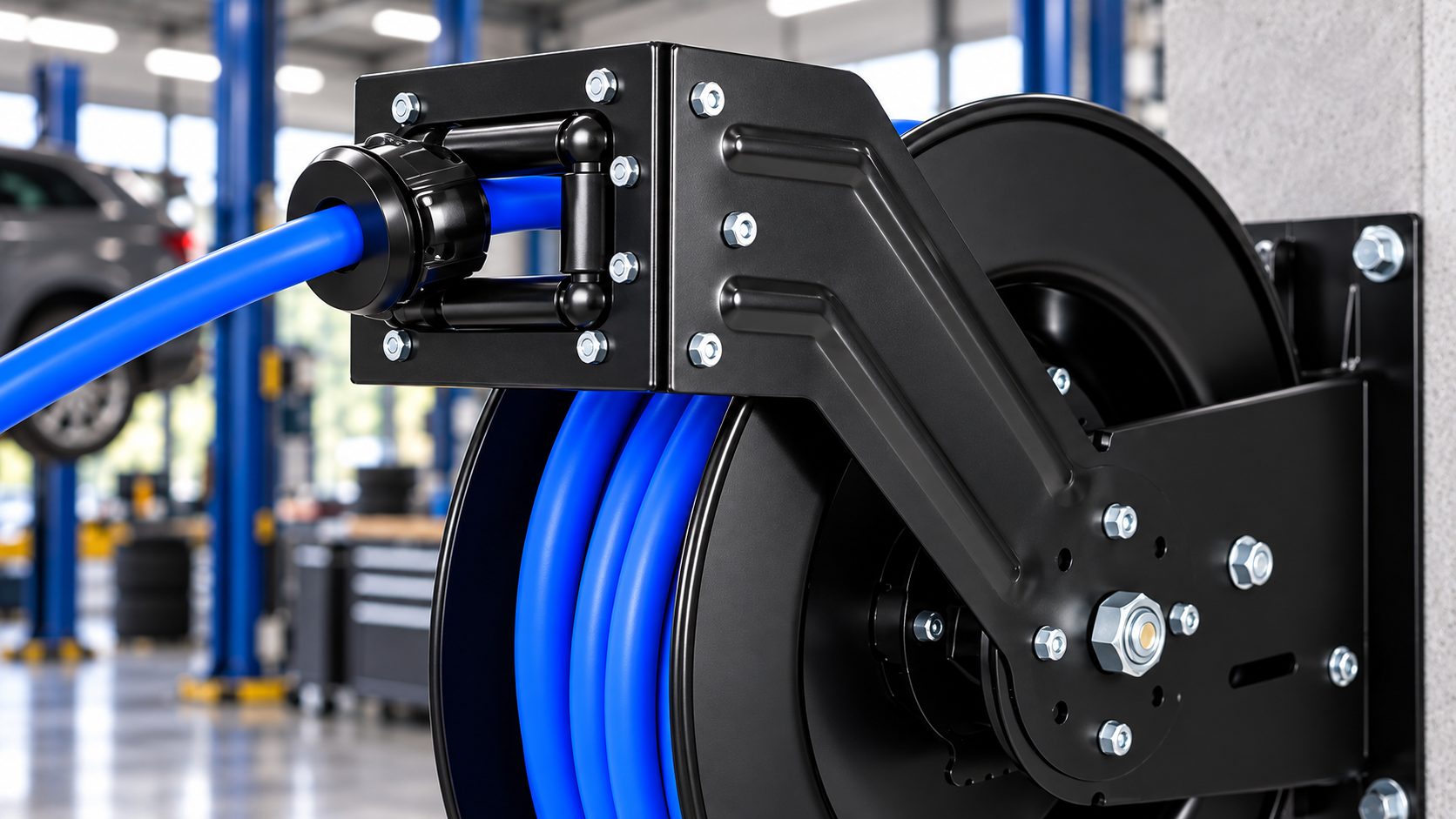
The illustrated model uses a formed metal frame with multiple fastened joints.
The frame supports the drum, spindle and guide assembly while transferring operational forces to the mounting structure.
Buyers should evaluate:
Frame material
Plate thickness
Formed reinforcement
Joint design
Fastener security
Surface treatment
Mounting-hole arrangement
Resistance to deformation
A visually heavy frame does not automatically confirm a specific load rating. Performance claims should be supported by drawings and testing.
3. The Hose Guide Assembly
The guide controls the path of the hose as it enters and leaves the drum.
The illustrated reel appears to use rollers around the hose opening. This arrangement may help reduce direct rubbing against the metal frame when the hose moves at an angle.
The guide should be evaluated for:
Roller material
Roller rotation
Opening dimensions
Hose clearance
Guide-arm position
Fastener accessibility
Wear resistance
Compatibility with the specified hose diameter
The hose should not be pinched between the rollers or dragged across an exposed metal edge.
4. The Rewind Mechanism
The internal rewind system determines how the hose returns to the drum.
Depending on the final product specification, the mechanism may include a spring assembly, ratchet system or other retracting structure. Its exact design should be confirmed before publishing technical descriptions.
Testing should consider:
Retraction force
Pull-out resistance
Locking behavior, if included
Rewind consistency
Hose distribution
Cycle durability
Performance at different extension lengths
Service and replacement requirements
A reel that retracts too aggressively may be difficult to control. A reel with insufficient force may leave part of the hose outside the drum.
5. The Hose and End Connection
The blue hose and metal connector are prominent parts of the illustrated configuration, but their technical suitability depends on the intended application.
Buyers should confirm:
Hose material
Inside and outside diameter
Hose length
Working-pressure requirement
Burst-pressure requirement
Temperature range
Bend radius
Connector material
Thread or coupling standard
Compatible fluid or gas
Relevant testing requirements
The hose should never be described as suitable for air, water, oil, grease or another medium unless its material and pressure specifications have been verified.
Why Mounting Position Matters
A reel can be manufactured correctly and still perform poorly if installed in the wrong location.
Possible mounting configurations may include wall, ceiling or other stable structural surfaces, depending on the reel design and approved installation method.
Before installation, users should verify:
Strength of the mounting surface
Required fastener type
Available structural support
Hose pulling direction
Clearance around the drum
Access for inspection and maintenance
Distance from heat, sharp edges and moving equipment
Local workplace-safety requirements
The mounting hardware and supporting structure must be suitable for the forces generated during hose extension and retraction.
Retractable Hose Reel vs Loose Hose Storage
Operating Factor | Retractable Hose Reel | Loose Hose Storage |
|---|---|---|
Storage position | Fixed and defined | May vary after each use |
Hose deployment | Selected working length | Often requires moving the full coil |
Rewinding | Assisted by the reel mechanism | Completed manually |
Floor organization | Can reduce loose hose on the floor | Hose may remain in walking areas |
Installation | Requires a suitable mounting point | Usually requires no installation |
Maintenance | Reel and hose require inspection | Primarily hose and fittings |
Best suited for | Repeated use at a defined workstation | Occasional or mobile use |
A retractable reel is most valuable where the hose is used repeatedly within a predictable working area.
Where Can This Reel Be Used?
Depending on the confirmed hose and connector specification, a heavy-duty retractable reel may be developed for:
Automotive garages
Vehicle-maintenance facilities
Manufacturing workshops
Assembly areas
Equipment-service stations
Warehouses
Agricultural workshops
Commercial maintenance departments
Application suitability must be confirmed according to the operating medium, pressure, temperature and installation environment.
Inspection Points for Buyers
A production sample should be evaluated through both dimensional inspection and functional testing.
Structural Inspection
Overall reel dimensions
Drum alignment
Frame geometry
Mounting-hole position
Guide-arm position
Fastener installation
Surface-finish consistency
Functional Inspection
Hose extension
Reel rotation
Retraction behavior
Guide-roller movement
Hose distribution on the drum
Connector condition
Leakage, where applicable
Cycle testing
Packaging Inspection
Protection around the connector
Drum immobilization
Hose-end restraint
Frame-edge protection
Hardware identification
Carton strength
Assembly or installation instructions
Shipping-label placement
Test standards and acceptance criteria should be agreed upon before mass production.
What Importers Should Confirm Before Ordering
An accurate request for quotation should include more than a reference image.
Buyers should provide:
Required hose length
Hose inside and outside diameter
Intended operating medium
Working and burst-pressure requirements
Operating-temperature range
Connector type and thread standard
Required mounting orientation
Retraction and locking requirements
Surface-finish specification
Testing and certification requirements
Estimated annual quantity
Packaging and destination-market requirements
These details directly affect material selection, mechanism design, product testing and final cost.
OEM/ODM Retractable Hose Reel Manufacturing
TWS Industries supports customized hose reel development for importers, wholesalers, industrial-equipment distributors and private-label brands.
Available development options may include:
Drum diameter and width
Frame dimensions
Metal material and thickness
Hose length and diameter
Hose color and material
Guide-arm configuration
Roller arrangement
Rewind mechanism
Locking positions
Connector and thread standards
Product color and surface treatment
Custom logo and labels
Installation instructions
Retail or industrial packaging
Barcode and shipping marks
Final specifications should be confirmed through technical drawings, approved samples and applicable performance testing.
A Better Way to Evaluate a Hose Reel
The most important question is not:
“How much hose can the reel hold?”
The better question is:
“How reliably does the complete system control the hose throughout repeated daily use?”
A well-developed retractable hose reel should create a smoother transition from storage to operation and back again. The drum, frame, guide, rewind mechanism, hose and connectors must work as one coordinated system.
When these elements are properly specified, the reel becomes more than a storage device—it becomes part of an organized workshop workflow.
Contact TWS Industries for OEM/ODM development, sample preparation and customized bulk-order quotations.