
7 Roof Cargo Basket Buying Mistakes You Should Avoid

7 Roof Cargo Basket Buying Mistakes You Should Avoid
Extra storage can make a road trip easier. Choosing the wrong roof basket can create problems before the journey even begins.
You've packed the luggage, camping equipment, and outdoor essentials. The vehicle is almost ready, but there's one problem: not everything fits inside.
A roof cargo basket seems like a practical answer. It provides an additional storage platform above the vehicle, allowing suitable equipment to be carried outside the passenger compartment.
However, not every roof basket fits every SUV, and a strong-looking steel frame does not automatically guarantee safe performance.
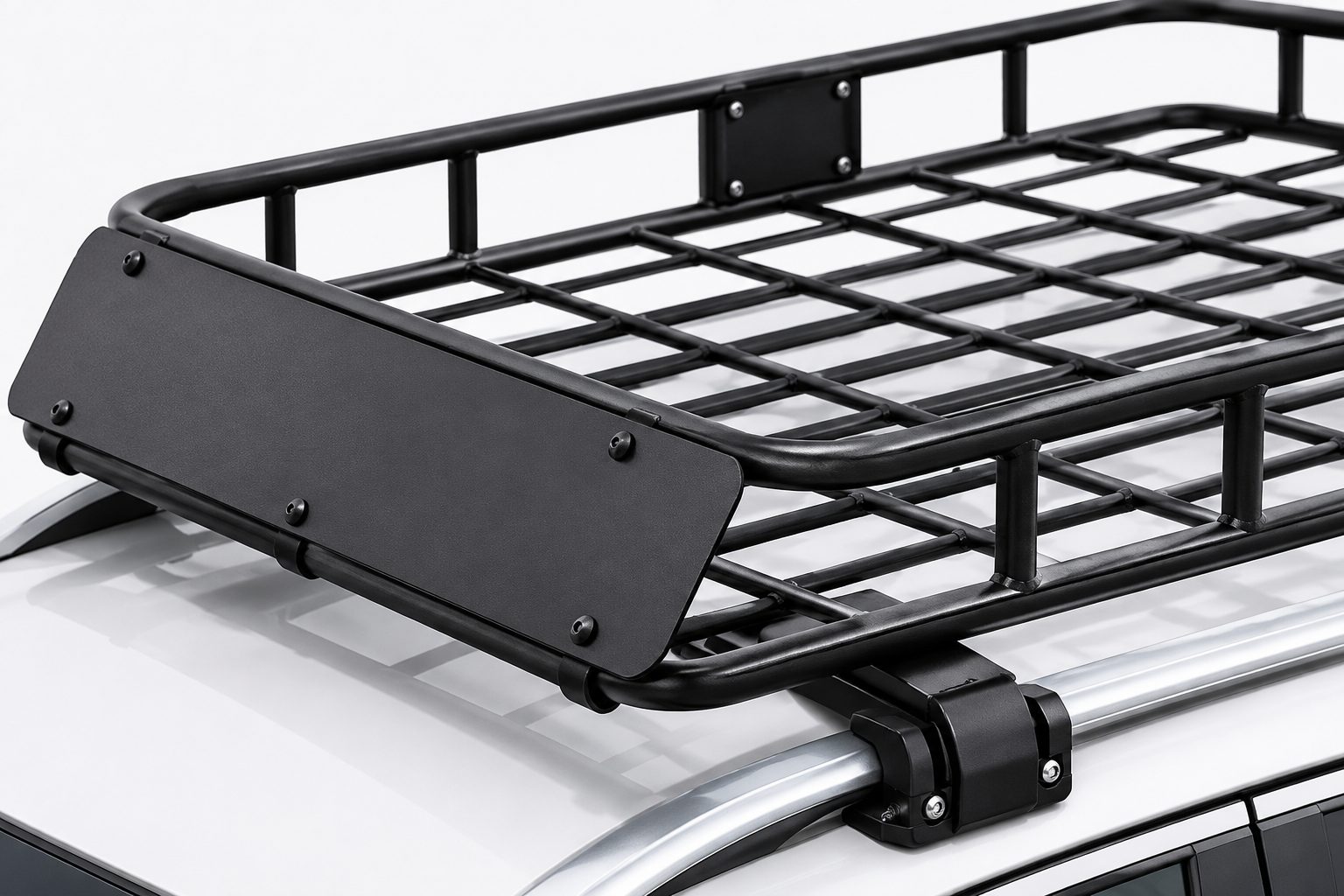
The featured Heavy Duty Steel Roof Cargo Basket combines a rectangular steel lattice platform, raised perimeter rails, a front wind deflector, and mounting hardware visible in its product images.
Before selecting this type of rooftop cargo carrier, it helps to understand seven common mistakes and how to avoid them.
01 | Choosing a Roof Basket Without Checking Vehicle Compatibility
Mistake #1: Assuming Every Roof Basket Fits Every SUV
One of the most common purchasing errors is choosing a basket based on its appearance without checking the vehicle's roof rack system.
Two SUVs may look similar but have very different roof configurations.
Some vehicles have raised side rails, others have flush rails, fixed mounting points, or factory-installed crossbars.
A roof cargo basket generally requires an appropriate mounting system, and the exact compatibility depends on the basket and vehicle specifications.
Before buying, verify:
Roof rack and crossbar configuration
Crossbar spacing and dimensions
Mounting bracket compatibility
Vehicle manufacturer requirements
Clearance around the roof and accessories
Installation instructions
A basket that looks suitable in a catalog photograph may still require different mounting hardware.
Buying Insight: Compatibility should always be confirmed using approved dimensions and installation specifications.
02 | Overlooking Size, Load Capacity and Weight Distribution
Mistake #2: Choosing the Wrong Basket Dimensions
A larger roof cargo basket offers more potential storage area, but larger does not always mean better.
An oversized basket may create installation challenges, interfere with roof accessories, or extend beyond the recommended mounting area.
Before selecting a model, buyers should evaluate the basket's external dimensions and usable cargo space.
The featured design has a rectangular steel-grid platform and raised surrounding rails, providing a defined area for compatible cargo.
However, its exact dimensions must be confirmed from the product specification.
Mistake #3: Confusing Basket Capacity with Vehicle Roof Capacity
A roof basket may have its own rated load limit, while the vehicle and roof rack have separate limits.
These values should never be treated as interchangeable.
The complete rooftop load includes the basket, mounting components, and cargo.
For safe use, the applicable vehicle roof, crossbar, mounting system, and basket limits must all be respected. Dynamic and stationary load ratings may also differ.
Questions buyers should ask:
What is the basket's verified load rating?
How much does the empty basket weigh?
What is the vehicle's permitted roof load?
What is the crossbar system's load limit?
How should cargo weight be distributed?
Practical Advice: Keep cargo securely restrained and follow the vehicle and rack manufacturers' instructions. A roof basket's published capacity never overrides the vehicle's permitted limits.
03 | Ignoring Aerodynamics and Corrosion Protection
Mistake #4: Underestimating Wind Noise
Rooftop accessories interact with airflow when the vehicle is moving.
Depending on their design and installation, roof baskets may generate additional wind noise and aerodynamic drag.
The featured model includes a front wind deflector.
This component is intended to influence airflow around the front of the basket.
However, actual noise reduction and aerodynamic performance would need to be demonstrated through relevant testing.
What Should Buyers Evaluate?
Front wind deflector design
Basket height and profile
Installation position
Mounting stability
Noise under normal driving conditions
Design Insight: A wind deflector is a useful design feature to evaluate, but it is not a guarantee of silent operation.
Mistake #5: Judging Steel Quality by Appearance Alone
A black steel roof basket may look durable, but exterior appearance does not reveal the complete material specification.
Roof-mounted equipment can be exposed to rain, moisture, road contaminants, sunlight, and changing temperatures.
For this reason, corrosion protection and structural quality deserve attention.
Important factors include steel grade, tube dimensions, weld quality, protective coating, and drainage details.
For importers, it is worth requesting information about coating adhesion, corrosion-resistance evaluation, and product inspection requirements.
Buyer Insight: A consistent protective finish and appropriate construction specifications are more meaningful than a visually attractive coating alone.
04 | Forgetting Cargo Security and Everyday Usability
Mistake #6: Assuming Raised Rails Are Enough to Secure Luggage
Raised side rails help define the cargo area, but they do not replace proper cargo restraint.
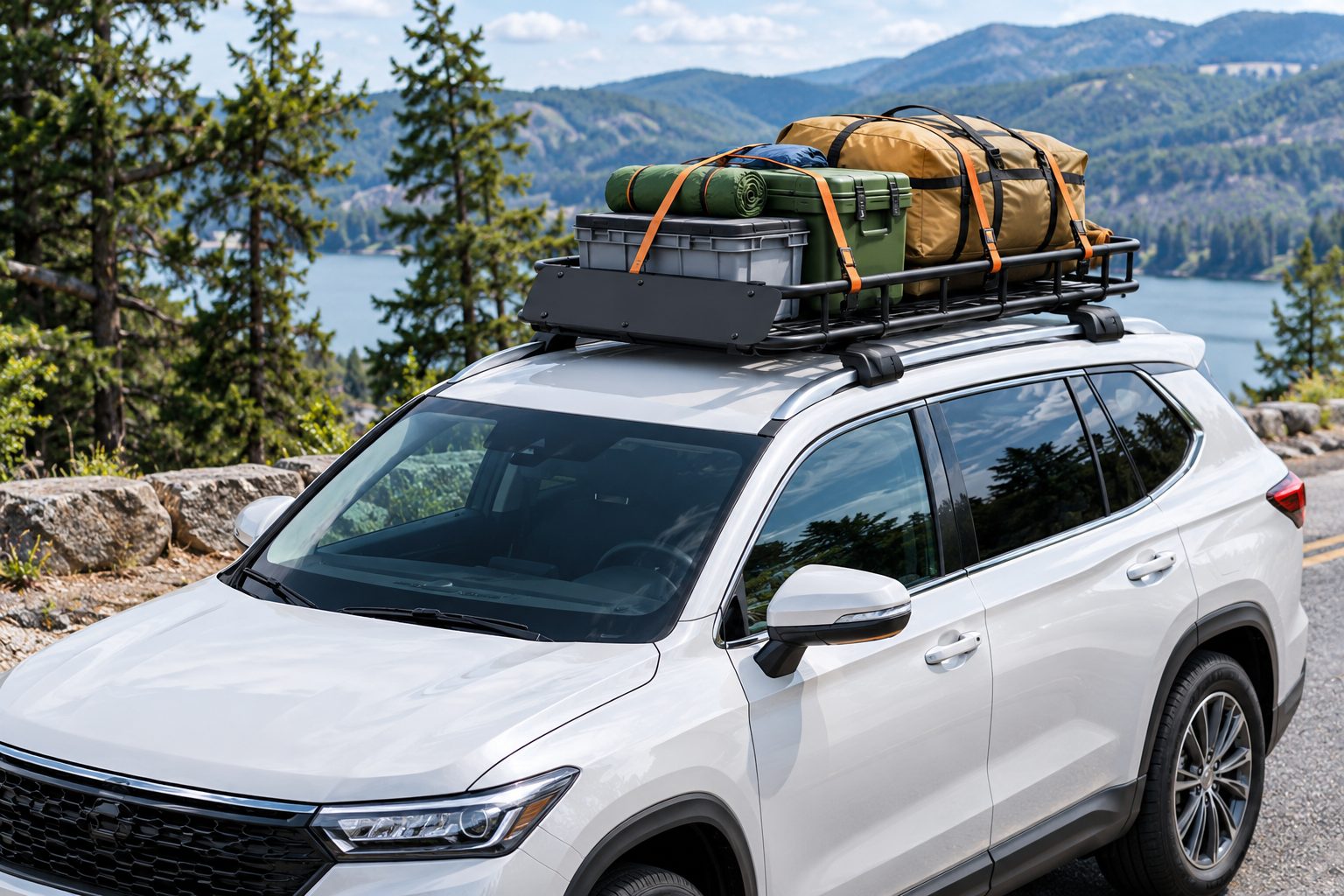
Luggage and outdoor equipment must be secured with appropriate straps or other approved restraints.
The securing arrangement should prevent movement during braking, cornering, and normal driving.
Practical Loading Considerations
Distribute weight according to manufacturer instructions.
Use cargo restraints suitable for the intended load.
Keep items within approved size and weight limits.
Check for interference with vehicle components.
Inspect mounts and restraints before travel and during appropriate stops.
Is a Roof Basket Better Than a Roof Cargo Box?
That depends on the type of equipment being transported.
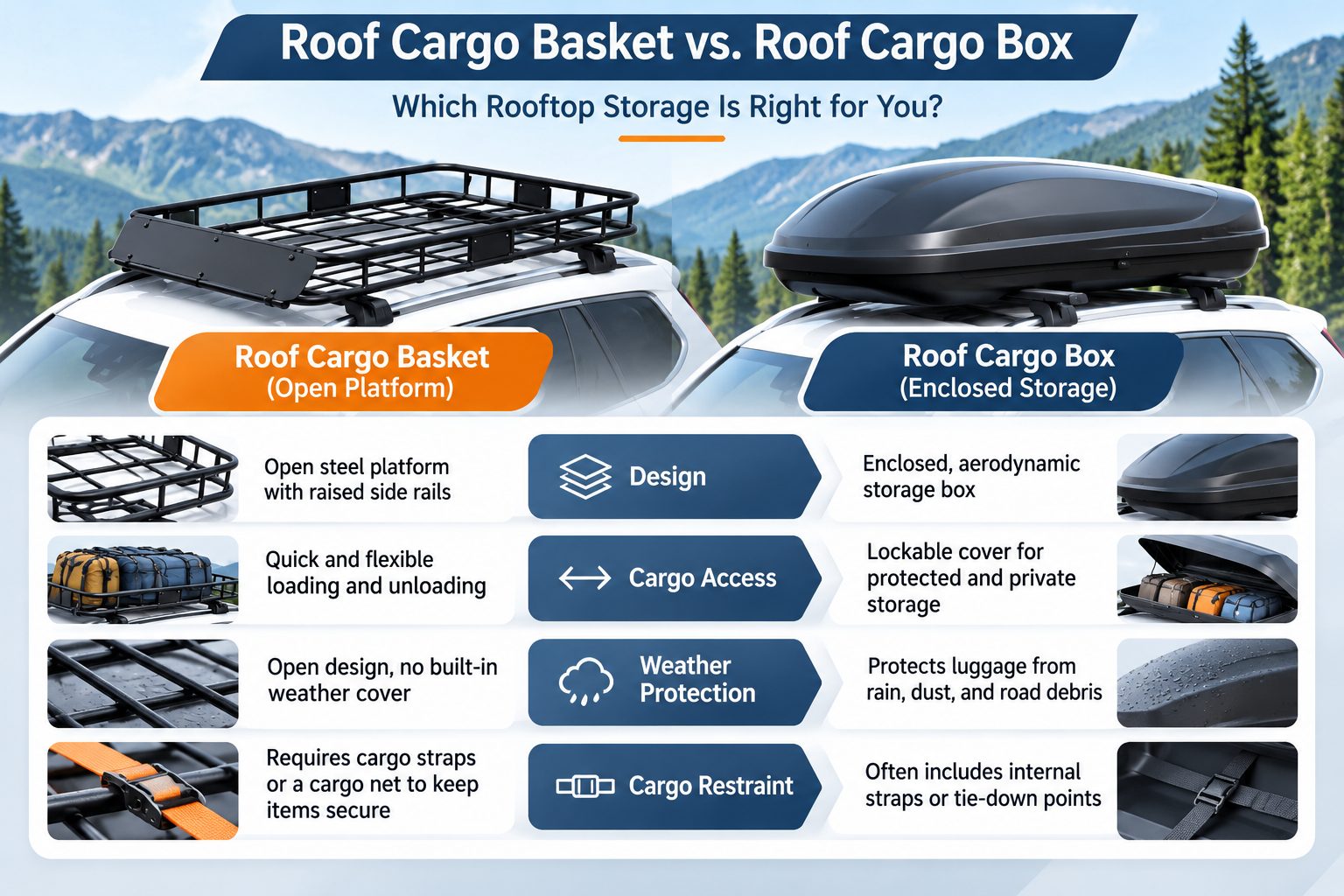
Feature | Open Roof Cargo Basket | Enclosed Roof Cargo Box |
|---|---|---|
Cargo Access | Open platform | Enclosed compartment |
Weather Protection | Additional protection may be needed | Depends on box design and seals |
Cargo Restraint | Suitable external restraints required | Internal restraint requirements vary |
Cargo Shape | Can accommodate compatible irregular items | Limited by box interior |
Main Consideration | Securing and weather exposure | Fit, access and internal capacity |
Neither option is universally better.
A roof basket is useful when buyers need an open cargo platform for suitably restrained equipment. A roof box may be preferable when an enclosed storage compartment is needed.
05 | Comparing Prices Without Evaluating Product Quality
Mistake #7: Choosing the Lowest Quotation Without Checking Specifications
For importers and distributors, the lowest unit price is not always the lowest total sourcing cost.
Two baskets may look almost identical in photographs while differing in construction, mounting hardware, protective finish, assembly requirements, or packaging.
A meaningful supplier comparison should include the complete product specification.
What Should Importers Check Before Placing an Order?
Materials and Construction
Confirm steel specifications, component dimensions, frame connections, and manufacturing tolerances.
Mounting System
Review compatibility, fastener requirements, mounting security, and installation instructions.
Product Validation
Define suitable load, structural, mounting, vibration, and corrosion-resistance evaluations as required by the target market and approved product design.
Packaging and Shipping
Review carton dimensions, disassembled versus assembled packing arrangements, protective materials, and transport testing requirements.
Commercial Requirements
Confirm MOQ, sample costs, production lead time, payment terms, tooling needs, and the applicable Incoterms.
A Practical RFQ Checklist
For an accurate quotation, prepare:
Approved drawings and dimensions
Steel and coating specifications
Required load performance
Mounting system requirements
Accessories and fasteners
Quality testing requirements
Packaging details
Expected annual volume
Destination market and target price
These details help buyers compare suppliers on a consistent basis.
06 | OEM/ODM Steel Roof Cargo Basket Manufacturing in Vietnam
Developing Products for Different Markets
Automotive retailers and private-label brands often require more than a standard product configuration.
Vehicle compatibility, mounting systems, product dimensions, finishes, and packaging may vary across markets and customer groups.
At TWS Industries, we welcome OEM/ODM metal automotive accessory development inquiries from international importers, wholesalers, distributors, and brand owners.
Potential customization includes basket dimensions, frame structures, wind deflector configurations, finishes, branding, packaging, and buyer-defined technical requirements.
All modifications are subject to engineering feasibility, sample approval, and production review.
For buyers sourcing products for the USA, Europe, and Australia, market-specific safety, labeling, installation, and compliance requirements should be reviewed before commercial production.
07 | Frequently Asked Questions
Can a Roof Cargo Basket Fit Any SUV?
No. Compatibility depends on the vehicle, roof rack configuration, crossbar specifications, mounting components, and manufacturer instructions.
How Much Weight Can a Roof Cargo Basket Carry?
Capacity depends on the specific basket, mounting system, and vehicle. The lowest applicable load limit must be respected, including the weight of the basket and mounting components.
Does a Roof Basket Wind Deflector Reduce Noise?
A wind deflector can influence airflow, but actual noise performance depends on the complete design, installation, and driving conditions.
Are Steel Roof Cargo Baskets Suitable for Outdoor Use?
They are intended for exterior mounting, but long-term performance depends on materials, protective finishes, maintenance, and environmental conditions.
Can Steel Roof Cargo Baskets Be Customized for OEM Brands?
Potential customization may include dimensions, steel frame details, mounting components, finishes, logos, and packaging, subject to technical approval.
Final Thoughts – Choose the Basket That Fits the Vehicle and the Journey
A roof cargo basket should do more than provide additional space.
It should fit the vehicle correctly, respect the approved roof load limits, support proper cargo restraint, and perform consistently under its intended operating conditions.
The featured Heavy Duty Steel Roof Cargo Basket offers a traditional open-platform design with steel lattice construction, raised rails, and a front wind deflector.
For importers and distributors, its commercial potential depends on verified specifications, dependable manufacturing quality, and a product configuration suited to the target market.
More storage is useful. The right design makes it practical.
Looking for an OEM/ODM Roof Cargo Basket Manufacturer in Vietnam?
TWS Industries welcomes RFQs from importers, wholesalers, automotive accessory distributors, retailers, and private-label brands.
Send your technical drawings, roof basket dimensions, material specifications, load requirements, mounting details, packaging expectations, target price, and estimated annual purchasing volume.
TWS INDUSTRIES | OEM/ODM Metal Products Manufacturer in Vietnam
Email: vivian.dang@tws-industries.com
Phone / WhatsApp: +84 889 399 339
Request Your OEM/ODM Quotation Today.